
Why Your Academic CV Is Getting Ignored and How to Fix It?
I once submitted fourteen adjunct applications in a single weekend.
I heard back from zero of them.
Not one email. Not one interview. Not one “we will keep your materials on file.”
I sat in my kitchen that Monday morning refreshing my inbox like the answer was going to magically appear if I checked one more time.
It did not.
At first, I thought the problem was me. I thought maybe I was not qualified enough. Maybe I did not have enough experience. Maybe the market was too competitive.
But that was not the real issue.
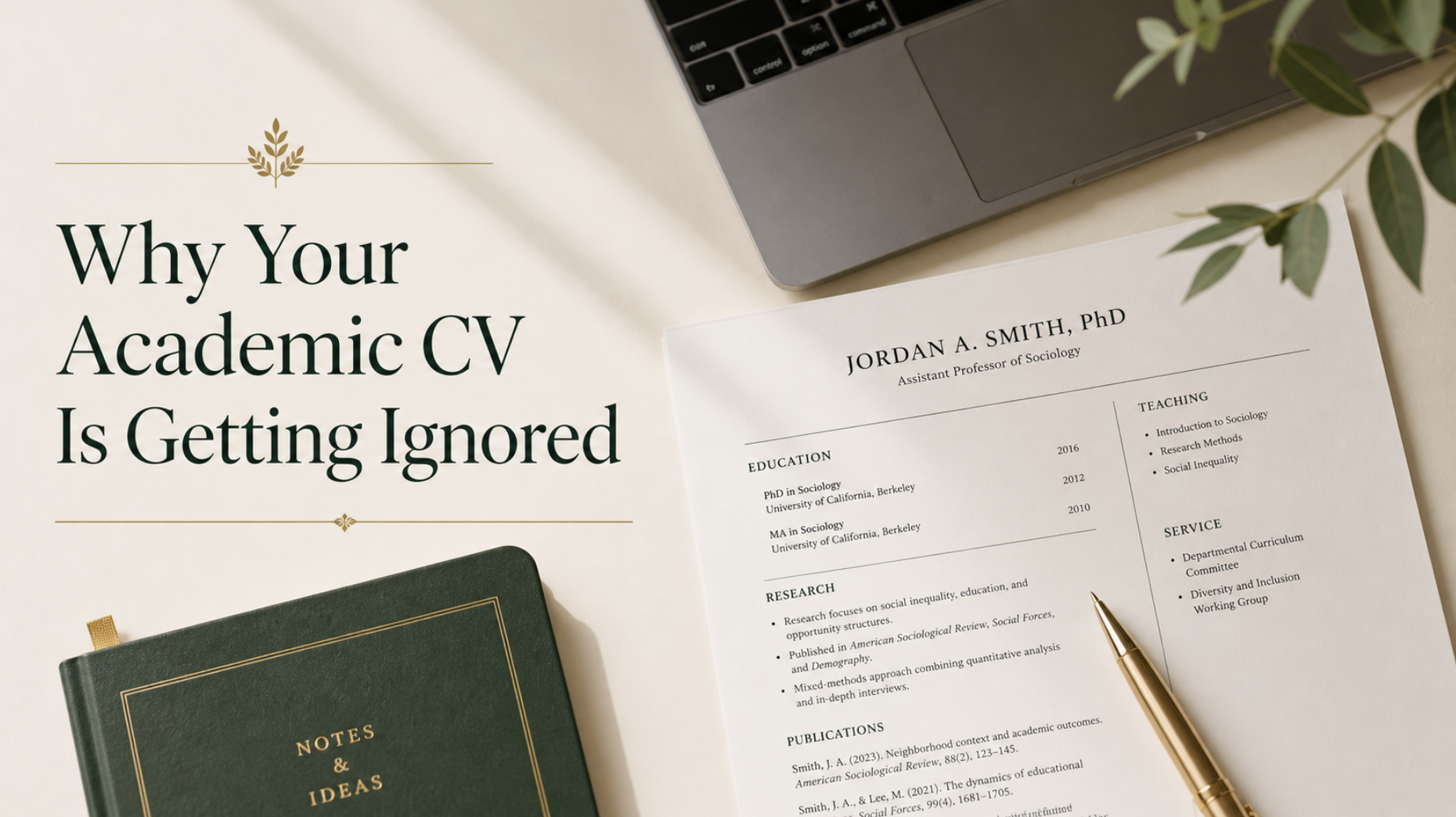
The issue was that my academic CV was not doing its job.
It was technically accurate, but it was not strategically positioned.
It listed my education. It listed my dissertation. It listed my research. It listed my experience.
But it did not immediately show hiring committees that I was ready to teach.
And that is where many PhDs lose the opportunity before anyone ever gets to know them.
Before You Apply Again, Start Here
If you are trying to land your first adjunct teaching role, your CV cannot just list what you have done. It has to show that you are ready to teach.
Free. Instant access.
The Ten Second Scan
Here is what you need to understand before you change a single line on your CV.
Adjunct hiring committees are usually reviewing several applications quickly. They are often trying to fill courses for the upcoming semester, sometimes with very little time.
That means they are scanning first.
They are not slowly reading every sentence of your CV.
They are looking for quick evidence that you have the credentials, teaching experience, and course readiness to step into the classroom.
Your CV needs to communicate three things in the first few seconds:
Your required academic credentials
Your teaching or training experience
Your readiness to teach specific courses
If those three things are not visible quickly, your application may get skipped even if you are qualified.
That is the hard truth.
Your degree matters, but your positioning matters too.
Why Is My Academic CV Getting Ignored?
Your academic CV may be getting ignored because it is written like a research document instead of a teaching document.
Adjunct hiring committees need to see your credentials, teaching experience, and courses you are prepared to teach within the first few seconds of reviewing your CV.
Want Me to Walk You Through This?
I break down life after the PhD, adjunct teaching, academic CV strategy, and how to stop feeling stuck after earning the degree on my YouTube channel.
Mistake 1: Your Dissertation Is the First Thing They See
Most PhDs place their education at the top of the CV, which makes sense.
But then they immediately follow it with the dissertation title, committee details, research interests, publications, and conference presentations.
That structure may work if you are applying for a tenure track research role.
But if you are applying for adjunct teaching jobs, it can bury the very thing the hiring committee needs to see first.
They are not only asking, “What did you research?”
They are asking, “Can this person teach our students next semester?”
The Fix
Keep your education near the top.
But after your education section, move directly into teaching experience or teaching related experience.
Your publications and research can still be included, but they should not dominate the top half of your CV if your goal is adjunct teaching.
Your CV should tell the committee:
“I am qualified, and I am ready to teach.”
Not:
“I am a researcher who may also be interested in teaching.”
That difference matters.
Mistake 2: Your Teaching Section Is Buried or Vague
This is one of the biggest problems I see.
Many PhDs have teaching experience, but their CV hides it.
It may be tucked under “Professional Experience,” “Graduate Assistantship,” “Other Experience,” or one small bullet that says “Assisted professor with course.”
That is not enough.
If you taught, supported instruction, graded, led discussions, created materials, tutored, trained, mentored, facilitated workshops, or supported student learning, that experience needs to be visible.
Adjunct hiring committees are looking for evidence that you understand the classroom.
Do not make them search for it.
The Fix
Create a dedicated section titled:
Teaching Experience
Or, if your background is broader:
Teaching and Student Support Experience
Each entry should include:
Institution or organization
Course name or subject area
Term or date range
Your role
One to two clear lines showing what you actually did
Do not just list the title.
Show the work.
For example, instead of writing:
“Teaching Assistant, Research Methods”
Write:
“Supported instruction for Research Methods by grading assignments, facilitating student discussion, and providing feedback on research design projects.”
That is clearer. That is stronger. That is more useful to the committee.
Your CV Needs More Than a Template
The Academic CV Toolkit helps you organize your CV so hiring committees can quickly see your teaching experience, course readiness, and academic qualifications.
$28. Instant access. Start applying this week.
Mistake 3: Your CV Reads Like a Dissertation Abstract
This one is going to hurt a little.
Some academic CVs are too academic for their own good.
Yes, you earned the degree. Yes, you know how to write at a high level. Yes, your research matters.
But your CV is not the place to prove how complex your thinking is.
Your CV needs to communicate quickly.
Hiring committees should not have to translate your sentences to understand what you can do.
If your CV sounds like a dissertation abstract, it may be working against you.
The Fix
Use clear, direct language.
Replace vague academic phrasing with concrete teaching actions.
Instead of:
“Engaged in pedagogical exploration of interdisciplinary learning practices.”
Write:
“Designed weekly discussion prompts to help students connect course concepts to workplace examples.”
Instead of:
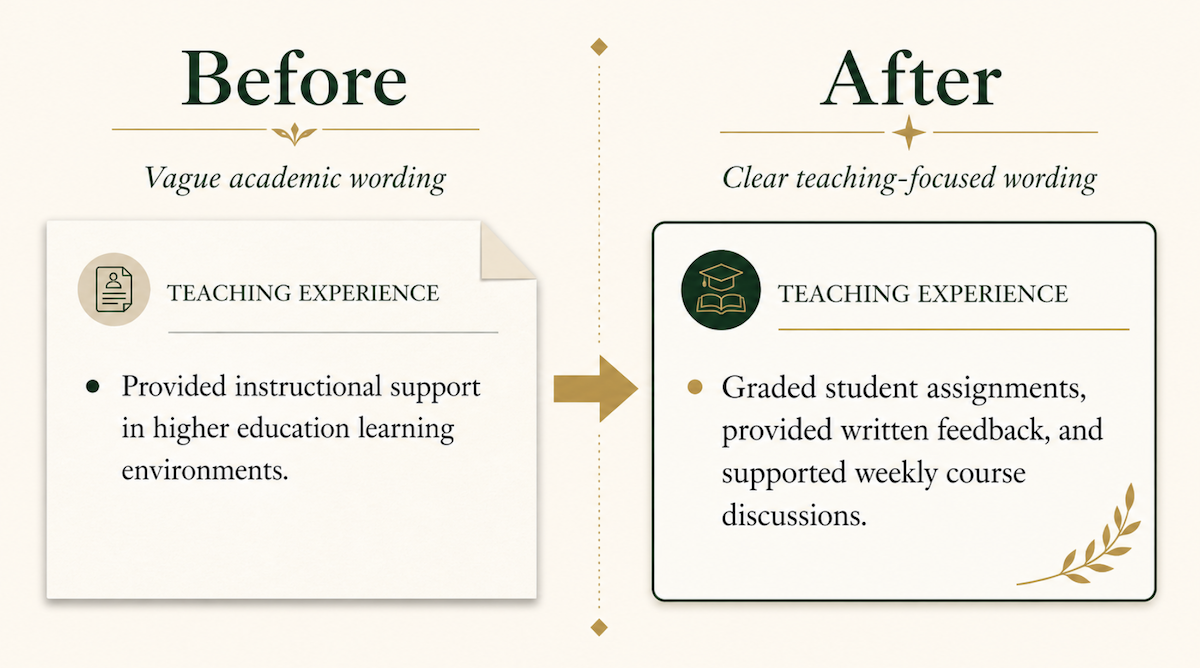
“Provided instructional support in higher education learning environments.”
Write:
“Graded student assignments, provided written feedback, and supported weekly course discussions.”
Do not make the committee guess.
Tell them exactly how you support student learning.
Mistake 4: You Do Not Have a Courses Prepared to Teach Section
This is one of the most overlooked sections on an academic CV.
It is also one of the most powerful.
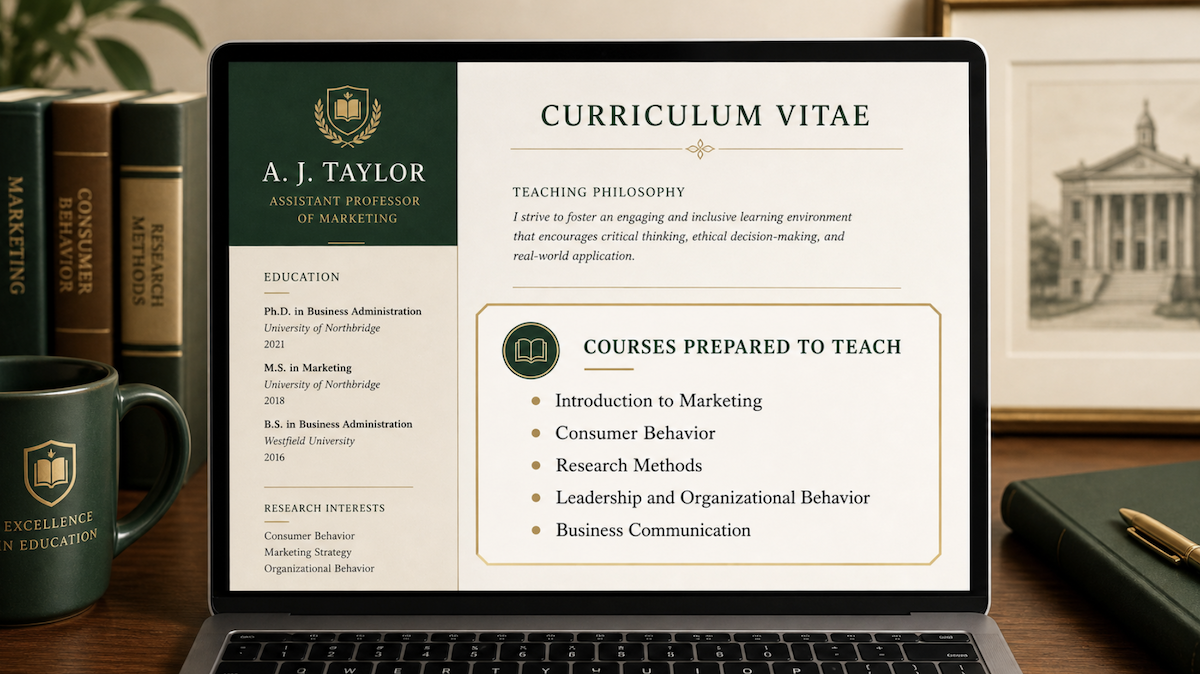
A Courses Prepared to Teach section tells a department exactly where you fit.
It shows that you have thought beyond your degree and can connect your expertise to actual courses.
That matters because adjunct roles are often filled based on immediate course needs.
A department may not be asking, “Who has the most impressive dissertation?”
They may be asking, “Who can teach Introduction to Marketing next semester?”
Or Research Methods.
Or Business Ethics.
Or Leadership.
Or Psychology 101.
Or whatever course is sitting on the schedule without an instructor.
The Fix
Add a section titled:
Courses Prepared to Teach
Then list five to eight courses you could realistically teach.
These should not be random. They should match your field, your experience, and the types of courses colleges actually offer.
For example, depending on your background, your list may include:
Introduction to Marketing
Consumer Behavior
Business Communication
Research Methods
Leadership and Organizational Behavior
Ethics in Business
Strategic Management
Diversity in the Workplace
This section does not guarantee an interview, but it helps a committee quickly understand how to use you.
That is the goal.
You are not just trying to look impressive.
You are trying to look hireable.
What Should I Include on an Academic CV for Adjunct Teaching Jobs?
An academic CV for adjunct teaching jobs should include education, teaching experience, courses prepared to teach, relevant professional experience, publications or presentations if applicable, and a short teaching philosophy statement.
The most important sections should be easy to find within the first few seconds.
Not Sure What Courses You Could Teach?
The free Adjunct Starter Kit will help you start thinking through how your degree, experience, and expertise can translate into adjunct teaching opportunities.
Free. Instant access.
Mistake 5: Your Formatting Looks Outdated
I am not telling you to make your CV trendy.
This is still an academic document.
But it should not look like it was built in 2008 and never touched again.
If your CV has tiny font, no white space, dense paragraphs, inconsistent spacing, and three pages of unbroken text, you are making the committee work too hard.
And busy people do not reward confusing documents.
They move on.
The Fix
Make your CV clean and easy to scan.
Use a professional font such as:
Calibri
Garamond
Georgia
Arial
Times New Roman, if it is formatted cleanly
Use bold section headers.
Add space between sections.
Keep bullet points concise.
Make institution names, roles, and course titles easy to identify.
Your CV should look like a document a busy academic can review quickly.
Because that is exactly what it is.
Mistake 6: There Is No Teaching Philosophy Anywhere
Many CVs make no reference to teaching philosophy at all.
That is a missed opportunity.
Your teaching philosophy helps the committee understand how you approach students, learning, feedback, and the classroom experience.
You do not need to put your full teaching philosophy statement on your CV.
But you can include a short one line teaching philosophy near the top of your teaching section.
The Fix
Add a short teaching philosophy statement under your teaching section header.
For example:
“I teach by translating complex theory into accessible application, with an emphasis on student voice, confidence, and real world learning.”
Or:
“My teaching approach centers on clarity, practical application, and helping students connect course concepts to their personal and professional goals.”
This gives the committee a quick sense of who you are as an instructor.
Then keep your full teaching philosophy statement ready as a separate document.
Many adjunct applications will ask for it.
Do not wait until they ask to start writing it.
Building Your Academic Brand After the PhD?
On YouTube, I talk about what happens after the doctorate, how to position yourself for adjunct roles, and how to turn your degree into real opportunities.
What I Want You to Take Away
Your academic CV is not getting ignored because you are unqualified.
You earned the degree.
You did the work.
You built the expertise.
But your CV may not be showing hiring committees what they need to see.
That is the part you can fix.
Your CV should not just prove that you completed a doctoral program.
It should show that you are ready to teach.
It should show the courses you can step into.
It should show how your experience connects to students, classrooms, and departments.
Your CV should make it clear that:
You have the academic background
You understand how to support students
You can teach specific courses
You are ready to step into the classroom
It should make it easy for a hiring committee to say:
“Yes, this person can teach for us.”
That is what strong positioning does.
And once I understood that, everything changed.
I stopped using my CV like a storage file for everything I had ever done.
I started using it like a teaching document.
That shift helped me get responses, interviews, and adjunct opportunities.
It can help you too.
Ready to Fix Your Academic CV?
If you know your CV needs work, do not keep sending the same version and hoping for a different result.
That is not strategy.
That is stress.
The Academic CV Toolkit was created to help PhDs and doctoral graduates organize their academic experience in a way that makes sense for adjunct hiring committees.
Inside, you will get support with positioning your experience, strengthening your CV structure, and showing that you are ready to teach.
$28. Instant access. Start applying this week.
Want the Free Starting Point First?
If you are not ready for the full toolkit yet, start with the free Adjunct Starter Kit.
It will help you begin thinking about how your PhD, professional experience, and teaching potential can become real adjunct opportunities.
Free. Instant access.
Watch More on YouTube
For more guidance on life after the PhD, adjunct teaching, academic CV strategy, and building income beyond the degree, watch the Doctor, Now What? series on YouTube
BLOG FAQ
Why is my academic CV getting ignored?
Your academic CV may be getting ignored because it is not showing hiring committees that you are ready to teach. If your teaching experience, course readiness, and credentials are not visible quickly, your application may be skipped.
What should be on an academic CV for adjunct professor jobs?
An academic CV for adjunct professor jobs should include your education, teaching experience, courses prepared to teach, relevant professional experience, publications or presentations, and a short teaching philosophy statement.
Should I include my dissertation on my academic CV?
Yes, but your dissertation should not overpower the CV if you are applying for adjunct teaching jobs. Keep it included, but make sure your teaching experience and courses prepared to teach are easy to find.
What is a Courses Prepared to Teach section?
A Courses Prepared to Teach section lists the college courses you are qualified and prepared to teach. This helps adjunct hiring committees quickly understand where you fit within their department.